G.I. Joe #21 or why I used a dictionary for a comic book with no words

One of the comic books I collected regularly was Marvel Comics “G.I. Joe: A Real American Hero.”  I was a fan of the toys (as was every other boy my age) and the cartoon, so naturally the comic book was right up my ally.  I was on board pretty much from the beginning and to be honest, the only issue of the entire run I am missing is #1.  The Marvel series ran for 155 issues and was written, for the most part, by Larry Hama.  G.I. Joe also held the distinction of being one of the only (if not THE only) comic book to be advertised on television.  The series had many unique qualities and milestones during its run, some good, some awful.  But the one the sticks out for me, and many others, is issue #21 “Silent Interlude.”

G.I. Joe #21
G.I. Joe #21

Issue #21 came out in March, 1984, and to me, it was way ahead of its time.  The entire issues contains no dialogue, and there is only one panel that contains words on a computer screen.  I didn’t quite get it at first, I thought maybe it was misprinted or something.  (as it turns out there was an urban comic myth that it was misprinted and shipped that way, but it turned out false)  But as I looked it over again and again I started to understand.  This was the first time I saw comic books as art.  There was one other thing that I didn’t quite understand: the title.  I had no idea what an “interlude” was.

I didn’t expect to see a five dollar word in a sixty cent comic.  Growing up, when I ran into a word I couldn’t pronounce or didn’t know the definition of, the answer I got was “sound it out” or “look it up!”  So I turned to our family dictionary.  Merriam-Webster dictionary defines interlude as ” a usually short simple play or dramatic entertainment.”  Doesn’t that sound like the definition of comic books in general?

The lesson I took away from this was that we never stop learning, even when immersed in the world of comic books.    Many people and parents look down on comic books as a waste of time, a detractor from “real reading.”  When I talked to my parents a few months ago about my reading differences, my father said “we never criticized you for reading comic books because you were reading.”  I am glad they had that attitude.
What To Read After: Green Lantern

After seeing “Green Lantern” on the big screen, it’s time to sit down and get to know The Corps a little better.  Here’s a good place to start.  This post may contain movie and comic book spoilers, so be warned!

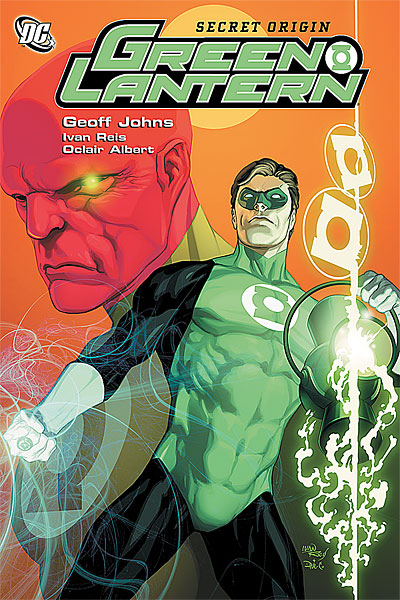
Green Lantern Secret Origin

Green Lantern Vol. 4 #29-35 It seem like issue #29 is a strange place to start, but is the most recent re-telling of Hal Jordan’s green beginnings.  These 6 issues are the basis for the movie, but go much deeper into story of Hal and the Corps.  Lots of character you saw in the movie are here, including Hector Hammond, Tom Kalmaku and, of course, Carol Ferris and Sinestro.  Written by the man responsible for reviving Green Lantern (among other characters of the past few years) and DC Comics Chief Creative Officer Geoff Johns, with art by the equally talented Ivan Reis.


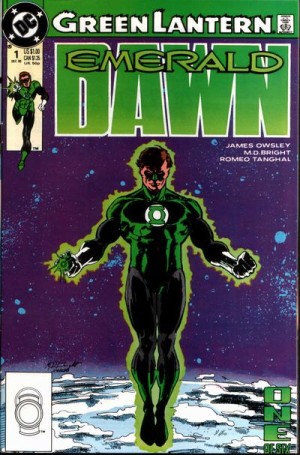
Green Lantern Emerald Dawn

Green Lantern Emerald Dawn # 1-6 An earlier and slightly different take on the origin story of Hal Jordan.  It is a little more gritty than the more recent telling.  There are elements from the movie, but this is before Parallax was introduced to the DC Universe, and also when the Green Lanterns could not control the color yellow.  The bad guy is Legion, a sort of mechanical hive of a dead planets consciousness.  Written by 1990’s icon Keith Giffen, Gerard Jones and Jim Owsley, with art by M.D. Bright and Romeo Tanghal.


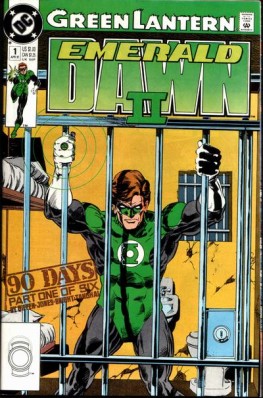
Green Lantern Emerald Dawn II

Green Lantern Emerald Dawn II #1-6  The sequel to Emerald Dawn, this mini-series deals with the training of Hal Jordan to become the Green Lantern of Sector 2814.  It also introduces Hal and Sinestro, his trainer.  Hal begins to discover the ways of the Green Lantern Corp…and the ways of Sinestro.  This sets the stage for a very long and rough relationship between these two.  It also introduces Guy Gardener, a future Green Lantern.  Also written by Keith Giffen and Gerard Jones with art by M.D. Bright and Romeo Tanghal.


Green Lantern Corps: Recharge

Green Lantern Corps: Recharge #1-5  This is a great place to learn about the Green Lantern Corps itself.  It follows the selection and training of several new recruits from all corners of the galaxy.  Hal Jordan isn’t featured much in this story, but Earth Lanterns Guy Gardener and Kyle Rayner, along with drill sergeant Kilowog.  This limited series later turned into the ongoing monthly series by the same name.  Written by Geoff Johns and Dave Gibbons and drawn by one of my favorite artists Patrick Gleason.


Plus, here’s a bonus: DC Comics online has a special Green Lantern 101 digital issue to catch you up.  It explains the Green Lantern Universe and has a few other cool stories.  Also, coming this September, DC Comics is rebooting their entire line of comic books, with all of them starting at issue #1.  This will be a great time to jump on board Green Lantern and 51 other DC Comics!

What To Read After: Green Lantern

After seeing “Green Lantern” on the big screen, it’s time to sit down and get to know The Corps a little better.  Here’s a good place to start.  This post may contain movie and comic book spoilers, so be warned!

Green Lantern Secret Origin

Green Lantern Vol. 4 #29-35 It seem like issue #29 is a strange place to start, but is the most recent re-telling of Hal Jordan’s green beginnings.  These 6 issues are the basis for the movie, but go much deeper into story of Hal and the Corps.  Lots of character you saw in the movie are here, including Hector Hammond, Tom Kalmaku and, of course, Carol Ferris and Sinestro.  Written by the man responsible for reviving Green Lantern (among other characters of the past few years) and DC Comics Chief Creative Officer Geoff Johns, with art by the equally talented Ivan Reis.


Green Lantern Emerald Dawn

Green Lantern Emerald Dawn # 1-6 An earlier and slightly different take on the origin story of Hal Jordan.  It is a little more gritty than the more recent telling.  There are elements from the movie, but this is before Parallax was introduced to the DC Universe, and also when the Green Lanterns could not control the color yellow.  The bad guy is Legion, a sort of mechanical hive of a dead planets consciousness.  Written by 1990’s icon Keith Giffen, Gerard Jones and Jim Owsley, with art by M.D. Bright and Romeo Tanghal.


Green Lantern Emerald Dawn II

Green Lantern Emerald Dawn II #1-6  The sequel to Emerald Dawn, this mini-series deals with the training of Hal Jordan to become the Green Lantern of Sector 2814.  It also introduces Hal and Sinestro, his trainer.  Hal begins to discover the ways of the Green Lantern Corp…and the ways of Sinestro.  This sets the stage for a very long and rough relationship between these two.  It also introduces Guy Gardener, a future Green Lantern.  Also written by Keith Giffen and Gerard Jones with art by M.D. Bright and Romeo Tanghal.


Green Lantern Corps: Recharge

Green Lantern Corps: Recharge #1-5  This is a great place to learn about the Green Lantern Corps itself.  It follows the selection and training of several new recruits from all corners of the galaxy.  Hal Jordan isn’t featured much in this story, but Earth Lanterns Guy Gardener and Kyle Rayner, along with drill sergeant Kilowog.  This limited series later turned into the ongoing monthly series by the same name.  Written by Geoff Johns and Dave Gibbons and drawn by one of my favorite artists Patrick Gleason.


Plus, here’s a bonus: DC Comics online has a special Green Lantern 101 digital issue to catch you up.  It explains the Green Lantern Universe and has a few other cool stories.  Also, coming this September, DC Comics is rebooting their entire line of comic books, with all of them starting at issue #1.  This will be a great time to jump on board Green Lantern and 51 other DC Comics!

Why Comic Books?

For me, Action Comics #463 was the first of many comic books.  But why did comic books stick with me?  Yes, there are the fantastical stories and the amazing art.  It went beyond that though, to a problem I did not even know I had.

From an early age, I had a difficult time with reading.  It was something that followed me all through grade school, junior high and high school.  In fact, it was in college where I discovered there was a possibility that I had a learning difference.  It was an English instructor that mentioned to me that I could be partially dyslexic.  This astounded me.  I didn’t even know there was such a thing.  A few years ago, I had the opportunity to do a psychoeducational evaluation that had some interesting results.  It turns out the I have a significant weakness in retrieval fluency.  Basically, it measures the ability to learn, store and retrieve a series of associations as well as ability to fully retrieve information from stored knowledge.  Ease of retrieval is very important in reading.  It was also discovered that I have visual memory weakness, which affects my reading and spelling.  I have a problem with swapping letters in words, or words themselves if they are similarly spelled (like properly for propriety).    This explained a lot, and spelled out (pun intended) why I had so many problems with reading and test taking all throughout school.

It also explained why I was so attached to comic books.  Reading straight text fatigued, frustrated and discouraged me.  The sheer size of a book would intimidate me (and still does sometimes).  But comic book are 22 pages long, give or take a few.  There are words, but also pictures to help with the story comprehension.  With comic books, I enjoyed reading, and still do.  I can plow through several in one sitting, not even realizing I have read 100+ pages.  Now, some of you will say “that’s cheating!  It is mostly pictures!”  Yes, a comic book would not be a comic book without the art.  But why do we read?  To gain information, to entertain, to explore our fantasies…all of these are valid reasons.  And all of these can be found in comic books too.  Now, this is not to say that a person should read comic books and nothing else.  But they can be used as a tool, as a gateway to the world of reading.  If people, especially kids, are excited about read, they will want to do more of it.  And that is not a bad thing!  It wasn’t until the last few years that I have pushed myself to read more regular books.  Time was, I would start a book, get frustrated and never finish it.  I still have difficulty reading, but I know that it is something I can overcome.  I still stumble and get frustrated, but I am working through it.  And I still read comic books.

I was ashamed of my reading difference.  I thought I was dumb.  I never talked about it until recent years.  It was comic books that got me through, that kept me reading.  And that is why they always have, and always will be, an important part of my life.

What To Read After: X-Men First Class

You saw “X-Men: First Class” and liked it.  So, now what?  Where do you start?  Fear not, I’m here to help.  This post may contain movie and comic book spoilers, so be warned!

X-Men First Class #1

X-Men First Class (Vol. 1 – 8 issues, Vol. 2 – 16 issues, Finals – 4 issues)  The name of these limited series are the same as the film, but the stories are different.  It is a modern take on the early days of the X-Men.  The role call is different from the film: Cyclops (Scott Summers), Marvel Girl (Jean Grey), Iceman (Bobby Drake),  and Angel (Warren Worthington III) who should not to be confused with the Angel that appears in the film.  Only Beast (Hank McCoy) was in the original line up of X-Men and is both in the film and this series.  Written by Jeff Parker, with art by Roger Cruz.


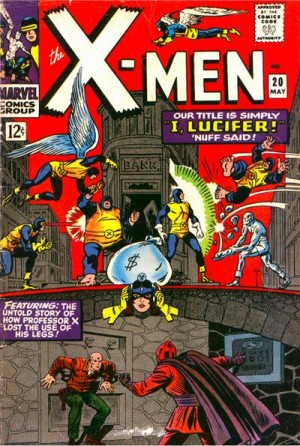
X-Men #20
X-Men #20

X-Men #20 An early story of the X-Men, in which they battle the evil alien Lucifer.  During the course of the story, Professor Xavier reveals that it is Lucifer that is responsible for his paralysis.  The Professor and Lucifer fought years before in Tibet, where Lucifer crushed the Professors legs with a boulder.  Written by Roy Thomas with art by Werner Roth.


X-Men #129
X-Men #129

X-Men #129  There are many firsts in this Marvel Milestone.  It contains the first appearance of Sebastian Shaw, Emma Frost and the Hellfire Club.  The story, however, has nothing to do with the movie.  Which is good, because you don’t want to just re-read the movie.  The down side is none of the X-Men you saw in the movie are in this issue, with the exception of Banshee and Havok who are only on one page.  It is written and drawn by the classic X-Men team of Chris Claremont and John Byrne, who dominated the 1980’s and set the bar for which all X-titles will be judged.  This first storyline featuring the Hellfire Club runs through issue #134, but continues without Shaw and company through issue #137.


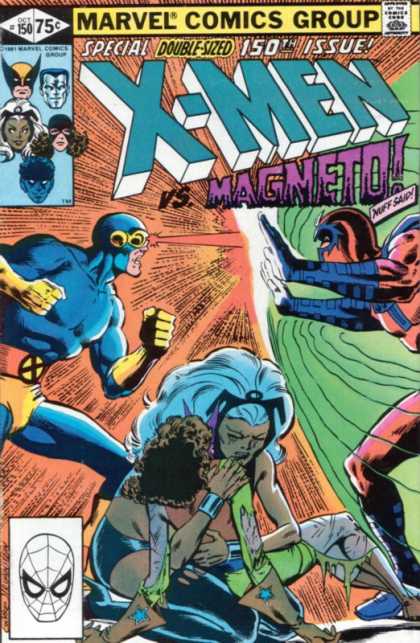
X-Men #150
X-Men #150

X-Men #150The are elements in this issue that we see in the film, with Magneto being the central focus.    The Russians attack Magneto’s island with a submarine, the X-Men arrive in the Blackbird and Magneto talking about his past are all pieces that inspired the film.  Again, another Chris Claremont story, with art by Dave Cockrum.


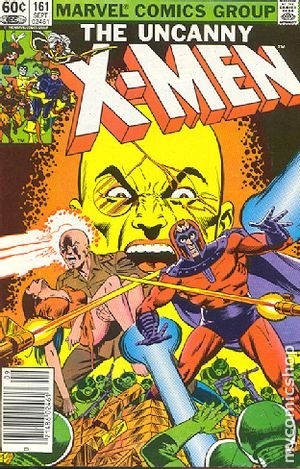
X-Men #161
X-Men #161

X-Men #161 A flashback issue that tells the story of Charles Xavier first met Magnus, a.k.a. Erik Lehnsherr, a.k.a. Magneto.  The surrounding story is that of Professor Xavier unconscious after an encounter with the Brood (a hostile extraterrestrial  life form that are not unlike alien from the movie ‘Alien’).  Their meeting is different than in the film, but it does involve fighting Nazis and discussing their philosophical differences.  Story by Chris Claremont and art by Dave Cockrum.     There are, of course, 46 years of other X-Men exploits to read, with many, many other titles and limited series.

My First Comic Book: Action Comics #463


Every comic book reader remembers their first time.  It is the nucleus a long and exciting adventure in the world of comic books.  It is your origin story.  Every superhero has one and so does every reader.  My comic origin began with Action Comics #463: “Die Now, Live Later!”

My First Comic Book!

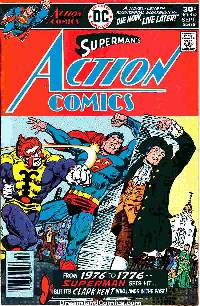
The year was 1976, and I was four years old.  For my birthday, my grandfather introduced me to what would become my boyhood hero: Superman!  That year I got a Superman figure, Superman beach towel, Superman pen and Action Comics #463, starring Superman.  (By the way, I do still have all of these things, even though the comic book has long since lost its cover.)  The cover featured Superman being slugged by a very colorful villain named Karb-Brak  from the year 1976 all the way back to 1776!  Well, who wouldn’t want to open it up and see how this could happen?

The first page has an image on it that will forever be burned on my brain.  It shows Superman standing with the founding fathers of our country signing the Declaration of Independence!  At age four, this changes everything!  SUPERMAN WAS AT THE SIGNING OF THE DECLARATION OF INDEPENDENCE?!?!  How could I not read on?  The story goes, Clark Kent (Superman’s secret identity) is in the year 1776, working as a reporter for the Pennsylvania Gazette.  His editor is “none other than Benjamin Franklin.”  Clark has no memory of being Superman or that he is from the future.  And his current assignment is to chronicle the signing of the Declaration of Independence.  Did I mention it was July 4, 1776?

Now this wouldn’t be Action Comics if there wasn’t excitement, right?  As Clark goes about his day, he discovers things that aren’t quite right.  He is able to stop a runaway horse carriage without a strain.  When rebel spies try to beat Clark up, it is his steel chin that breaks the hand of his assailant.  It is then, when he sees his reflection in a mirror that he realizes who he truly is:  the Man of Steel!  He remember everything.  He remembers that he belongs in the year 1976 and that Karb-Brak sent him to the past because he is deathly allergic to Superman.  You read right.  Karb-Brak is from a planet from another galaxy full of beings with superpowers.  But he had to leave because of his allergy.  Earth was the only place he could go, but then he found Superman caused the same allergic reaction and he had to get rid of him.  So instead of killing him, Karb-Brak sends Superman 200 years in the past with the help of a time ray.  This is a lot for a 4-year-old to wrap his head around.

Without going too much farther into the story, Superman foils a plot by spies to steal the Declaration of Independence, flies forward in time and defeats Karb-Brak once and for all!  And once again the world is safe thanks to the Man of Steel!  And I was hooked!  Wow!  Anything could happen in the world of comic books.    It was this exciting, albeit strange story that would send me down the road of comic books for many, many years to come.  I would find adventure.  I would find disappointment.  I would find sadness.  But most of all, I would find years of joy.

Thanks Grandpa!